Is Gaztelugatxe Worth Visiting?
How impressive Gaztelugatxe really is, how hard the 241-step climb is, how crowded it gets, how long you need — and who should skip it. An honest verdict, both ways.
Yes — for most people, and with two caveats that matter more than the usual ones. Gaztelugatxe is a genuinely extraordinary piece of coast, and it is also a small site that takes about two hours, gates its visitors with timed slots, and asks for a kilometre of descent and 241 stone steps before it gives you anything. The visitors who come away disappointed are almost always the ones who expected a destination and found a landmark.
Check Availability
How impressive is it, really?
Very. This is not a case of a modest site inflated by a television credit.
A rocky islet is tied to the Bizkaia coast by a stone causeway that switches back on itself and climbs to a small hermitage on the summit. Below it, the Bay of Biscay works on a coastline of flysch — layers of seabed rock tilted almost vertical and cut by the Atlantic into arches and sea stacks. The hermitage has been there in some form since the 9th century, became a convent in the 12th, was demolished in 1886 and rebuilt. At the top, the custom is to ring the bell three times and make a wish.
The photographs are honest, which is not always true of famous places. What they cannot show is the wind, the noise of the swell under the bridge, and the fact that the whole structure is only about as wide as a footpath for much of its length.
How hard is the climb?
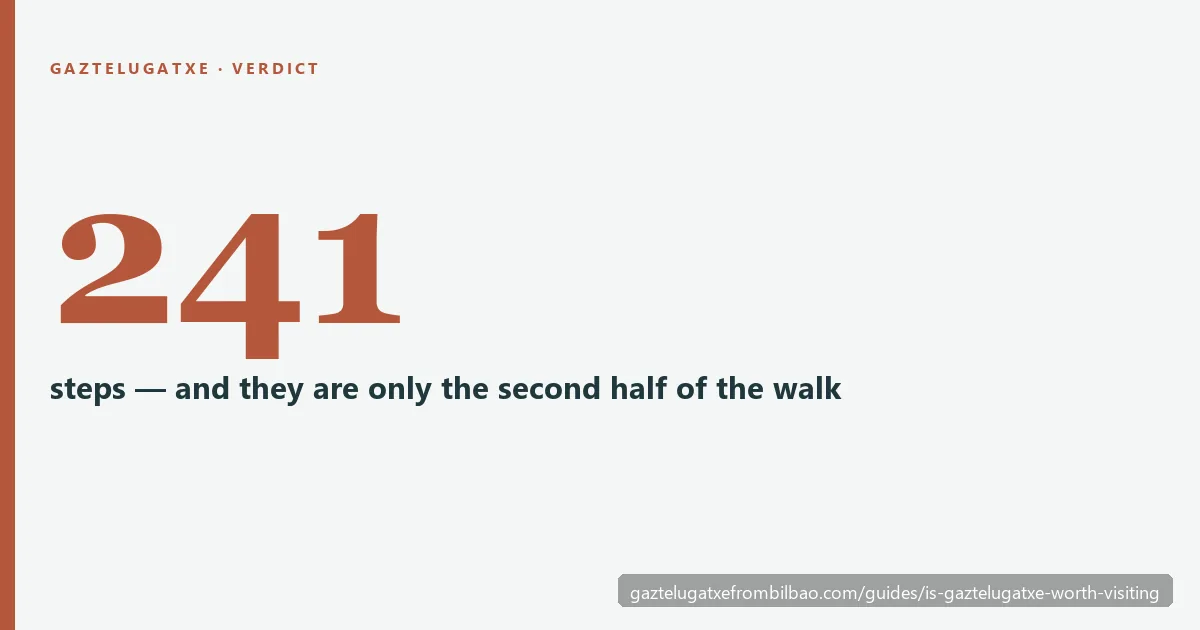
Harder than the “241 steps” figure suggests, because the steps are the second half.
From the car park you first descend on one of two paths: Urizarreta, 1.2 km at roughly a 35% gradient with steps, or Ermu, 1.6 km, paved and traffic-free at about 15%. Then the causeway, then the staircase, which most people take 25 to 35 minutes to climb. Then all of it again in reverse — and the return is the uphill one.
Operators are unusually blunt about who should not attempt it. Every climb-inclusive tour on this site lists it as unsuitable for wheelchair users and travellers with mobility impairments; several add a low fitness level; one declines under-12s and sets a 140 kg limit. Take those at face value. This is not a boilerplate disclaimer, it is a narrow stone staircase with two-way traffic and a long exposed section.
If the climb is out, the trip is not: the four-hour coastal tour goes to a viewpoint above the islet and never crosses to it, and it carries the highest rating on this site.
How crowded is it, and how long do you need?
Crowded enough that the provincial council caps daily numbers and issues free timed reservations on the busy dates — in 2026, every day from mid-June to September 20, over Easter and on most spring and October weekends. Popular weekend slots can sell out: on October 1, 2026 several October weekend days had none left.
The cap is what makes the site bearable. Within your slot the staircase is busy but moving; the crush happens in the car park and at the entrance, not on the rock. Early slots and shoulder-season dates are noticeably quieter.
Two hours covers it. The descent, the causeway, the climb, time at the top, the return. That is why tour durations mislead: the ten-hour flagship allocates 110 minutes at the islet and the six-hour minibus allocates two hours. Anything longer is being spent somewhere else.
Is it worth it if you are not a Game of Thrones fan?
Yes, and the series is arguably a distraction. Gaztelugatxe stood in for Dragonstone in season seven, and the surge of attention that followed is the reason the site now needs a booking system at all. But what you are walking up to is a medieval pilgrimage chapel on an Atlantic sea stack, with a 9th-century history and a bell you ring for luck. Nothing about the walk depends on recognising it.
The guides on the group departures split roughly the same way. Some lead with the filming positions; the small-group operator on the half-day walk talks about the ecology of the headland and what the chapel means to people who live nearby.
Is it worth it in bad weather?
Often, yes — and the Bay of Biscay does not offer many alternatives. Tours run rain or shine, and the site in heavy swell is more dramatic than the site in flat sunshine. The council has closed access in bad weather, as for an orange wave alert in September 2020 and a storm in January 2023, and it advises against climbing to the hermitage on orange-alert days.
What changes is comfort rather than spectacle. The causeway is exposed, the stone is slick, and the wind at the top is genuinely strong. Shoes with grip and a waterproof shell make the difference between a memorable hour and a miserable one.
Who should skip it
Anyone who cannot manage stairs or a steep kilometre, unless you take a viewpoint-only tour. Anyone with one day in Bilbao — the Guggenheim, the Casco Viejo and the pintxos bars are a stronger use of it, and Gaztelugatxe deserves a day of its own. Anyone expecting a village: there is a chapel, a bell and a view, and the nearest food is back up at the road. And anyone unwilling to deal with the reservation in high season, because the alternative is arriving and not going up.
Everyone else: yes. The tours we track average 4.3 to 4.9 across more than 7,000 reviews, which is a strong consensus for a site with a real climb in it. If you have decided, the which tour should you book guide narrows seven departures to one, and how to get there from Bilbao covers the transport if you would rather go independently.
See Dragonstone for Real — From Bilbao, in a Day
Rated 4.7/5 by more than 3,000 guests. Bilbao pickup, guaranteed Gaztelugatxe access, Bermeo, Mundaka, Gernika and a txakoli tasting. Free cancellation up to 24 hours before.
Check Availability & Book